Jain Irrigation Systems Ltd.
   Jain Irrigation Systems Ltd.

Home

Company

Solution for

Products& Services

Site Map

Reach us

Jains share in Agriculture

Plant Tissue Culture

More Crop Per Drop™

Drip Irrigation Systems
Sprinkler Irrigation Systems
Control and Safety Valves
Water Filtration Systems
Fertigation System & Chemigation Equipment
Pipes and Fittings
Turnkey Project Services
Green Houses
Plant Tissue Culture
Nursery Plants and Systems
Biofertilizer
Agri & Engineering Consultancy
Processed Food
Plastic Sheet
Solar Water Heating System


Jain Tissue Culture Accredited ISO 9001-2000 Certification by RWTUV of Germany


Locate us


Submit Your Remarks

Plant Jain Tissue Culture Banana, take Bumper Yield !!!

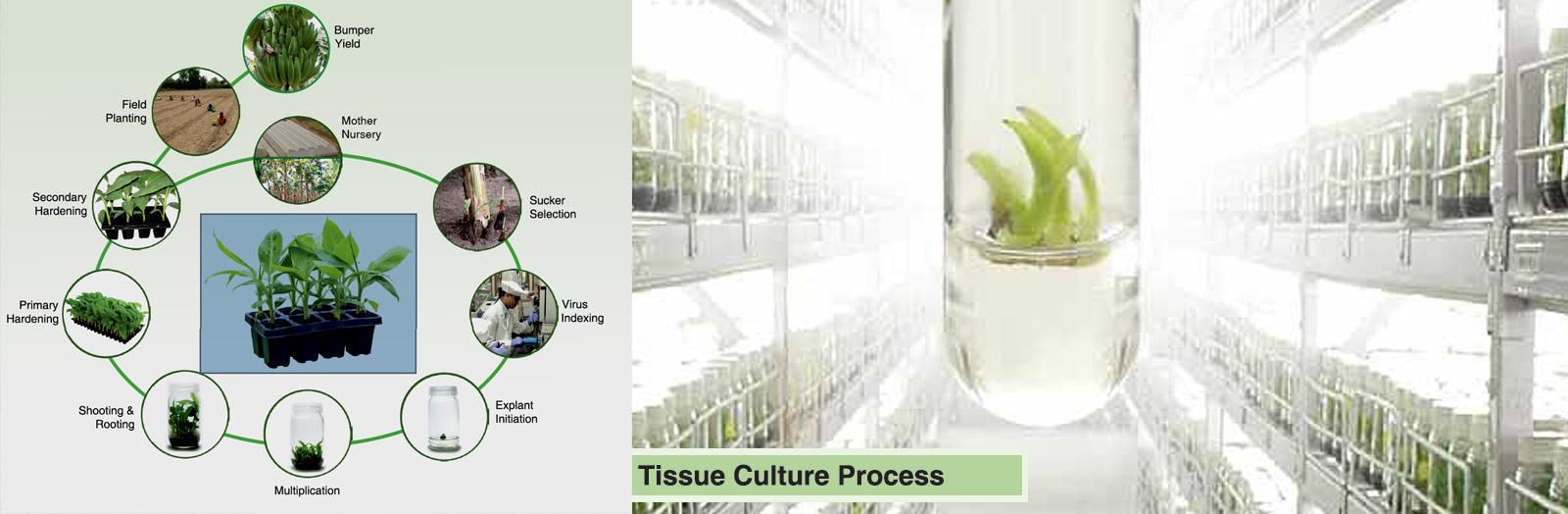
Tissue Culture

What is Tissue Culture ?

The propagation of plant by using plant part or single cell or group cell in test tube under very controlled and hygienic conditions is called "Tissue Culture".

Status in India

Banana is globally important fruit crop with 97.5 million tones of production. In India it supports livelihood of million of people. With total annual production of 16.91 million tones from 490.70 thousand ha., with national average of 33.5 T/ha. Maharashtra ranks first in production with 60 T/ha. Banana contributes 37% to total fruit production in India.

Banana is one of the major and economically important fruit crop of Maharashtra. Banana occupy 20% area among the total area under crop in India. Maharashtra ranks second in area and first in productivity in India. Jalgaon is a major Banana growing district in Maharashtra which occupy 50,000 hectares area under Banana. But most of Banana is grown by planting suckers. The technology development in agriculture is very fast, it results in developing Tissue Culture Technique and methods.

Agro climate

Banana is basically a tropical crop, grows well in temperature range of 13ºC – 38ºC with RH regime of 75-85%. In India this crop is being cultivated in climate ranging from humid tropical to dry mild subtropics through selection of appropriate varieties like Grandnaine. Chilling injury occurs at temperature below 12ºC. The normal growth of the banana begins at 18ºC, reaches optimum at 27ºC, then declines and comes to a hault at 38ºC. Higher temperature causes sun scorching. High velocity wind which exceeds 80 km phrs damages the crop.

Soil

Soil for banana should have good drainage, adequate fertility and moisture. Deep, rich loamy soil with pH between 6-7.5 are most preferred for banana cultivation. Ill drained, poorly aerated and nutritionally deficient soils are not suitable for banana. Saline solid, calcareous soil are not suitable for Banana cultivation. Avoided soil of low laying areas, very sandy & heavy black cotton with ill drainage.

A soil that is not too acidic & not too alkaline, rich in organic material with high nitrogen content, adequate phosphorus level and plenty of potash are good for banana.

Varieties

In India banana is grown under diverse conditions and production systems. Selection of varieties, therefore is based on a large number of varieties catering to various kinds of needs and situations. However, around 20 cultivars viz. Dwarf Cavendish, Robusta, Monthan, Poovan, Nendran, Red banana, Nyali, Safed Velchi, Basarai, Ardhapuri, Rasthali, Karpurvalli, Karthali and Grandnaine etc.

Grandnaine is gaining popularity and may soon most preferred variety due to its tolerance to a biotic stresses and good quality bunches. Bunches have well spaced hands with straight orientation of figures, bigger in size. Fruit develops attractive uniform yellow colour with better self life & quality than other cultivars.

Land Preparation

Prior to planting banana, grow the green manuring crop like daincha, cowpea etc. and burry it in the soil. The land can be ploughed 2-4 times and leveled. Use ratovator or harrow to break the clod and bring the soil to a fine tilt. During soil preparation basal dose of FYM is added and thoroughly mixed into the soil.

A pit size of 45cm x 45cm x 45cm is normally required. The pits are to be refilled with topsoil mixed with 10 kg of FYM (well decomposed), 250 gm of Neem cake and 20 gm of conbofuron. Prepared pits are left open for 15-20 days for solar radiation to kill all the insects, soil born diseases and for aeration before refilling. In saline alkali soil where pH is above 8 Pit mixture is to be modified incorporating organic matter and gypsum. Organic matter and pyrite in saline soil to improve the soil quality. Instead of pit you can plant in ferrow can be open at required spacing and planting should be done 2-3 inch deep.

Jain Drip
Polyethylene Hose & Tubes
Emitting Devices
Spray heads and Jets
Poly Fittings & Accessories
Sprinkler Irrigation Systems
Lawn & Garden Pop-ups
Overhead Sprinkler
Jain Valves
Plastic Control Valves and Safety Valves
Filtration System
Sand Separator
Screen filter
Media Filters & Manifolds
Backwash Controller
Fertigation Systems & Chemigation Equipments
Jain Fertilizer Tank
Jain Fertilizer Injector
Ventury Injector
J-Injector Pump
Manifold Fertigation
Jain Pipe and Pipe Fittings
PVC Pressure Pipes (Solvent Welded) / Quick Fix™ PVC Pipe (Rubber Ring Joint Pipes)
Jain PVC Cable Duct
Jain PVC Well Casing and Screen Pipe
Jain Sure-Loc® Well Casing and Screen Pipe
Jain Sure-Loc® Column Pipe
HDPE Pipes
Quick-Connect® PE Pipes
HDPE Sure-Loc® Pressure Pipes and Pipe Fittings
Jain PE Duct
Polyethylene Gas Piping System
Design-Technical Information
Units and Conversions
Design Data
Container Loading Details
Chemical Resistance Table
Warranty
Trade Mark
Certifications
Catalogues, Papers and Manuals (PDF files)
Banana Tissue culture - in Marathi Language
Irrigation Product Catalogue
Hi-Tech Banana Production practices
Plant Tissue Culture Banana, take bumper yield [English] 
[Marathi]  [Gujarathi]  [Hindi]
Micro Watershed to Micro Irrigation
Improved Agro techniques for Sugarcane Under Drip System
[English] [Marathi] [Kannad]
Drawbacks in Conventional Irrigation Methods
Agricultural services offered by JAINS

Next

Top

© Jain Irrigation Systems Ltd.
Site enabled by : Jainart    Best viewed in 800 × 600 Resolution with Internet Explorer 4.0 and higher